Quick Answer
A refurbished phone may have been repaired before being resold, but that doesn’t automatically make it a bad purchase. The safest way to check is by inspecting the device for signs of replacement parts, reviewing the seller’s refurbishment process, checking battery health, verifying IMEI details, testing all major functions, confirming the warranty and buying from a trusted UK retailer. Professionally refurbished phones are carefully repaired, tested and quality checked, whereas poorly repaired devices often show cosmetic flaws, inconsistent performance or missing quality assurance.
In This Guide
In this complete UK buyer’s guide, you’ll learn:
- What “repaired” actually means on a refurbished phone
- Whether previous repairs should concern you
- Common repairs carried out during refurbishment
- How to check if a refurbished phone has been repaired before
- Warning signs of poor-quality repairs
- Questions to ask before buying
- How professional refurbishment differs from ordinary second-hand repairs
- Why choosing a trusted UK refurbishment specialist matters
- Frequently Asked Questions
Why So Many Buyers Ask This Question?
The refurbished smartphone market has grown rapidly across the UK over the last few years. More people than ever are choosing refurbished devices because they offer excellent value, lower environmental impact and significant savings compared with buying new.
However, many buyers still worry about one thing:
Has this phone been repaired before, and if so, can I trust it?
This concern is understandable. Some people imagine that any repaired phone is unreliable or has been badly damaged in the past. Others assume that every refurbished phone contains cheap replacement parts or hidden defects. In reality, neither assumption is necessarily true.
Many refurbished phones have never required any hardware repairs at all. Others may have received a professional battery replacement, a genuine screen replacement or another approved repair as part of the refurbishment process. When completed correctly by experienced technicians, these repairs restore the phone to excellent working condition and help extend its usable life.
The key isn’t whether a phone has been repaired – it’s how the repair was carried out, who performed it and how thoroughly the device was tested afterwards. That’s why understanding the refurbishment process is just as important as understanding the repair itself.
If you’re still deciding whether refurbished devices are the right choice, our guide on Are Refurbished Phones Good? explains the advantages, potential drawbacks and what buyers should expect before making a purchase.
What Does “Repaired” Mean on a Refurbished Phone?
One of the biggest misconceptions is that every refurbished phone has undergone major repairs.
That isn’t true. The word “refurbished” simply means that a pre-owned device has been professionally inspected, tested and prepared for resale. The amount of work required depends entirely on the condition of the individual phone.
For example:
- A phone returned during a retailer’s returns period may only require testing, cleaning and secure data wiping before it can be resold.
- Another device may need a new battery because its original battery health has fallen below acceptable standards.
- A third phone might require a replacement display after cosmetic or accidental damage.
- Some devices may only receive software updates and diagnostic testing without any hardware repairs at all.
In other words, refurbishment isn’t defined by repairs – it’s defined by quality restoration. A reputable refurbishment process focuses on ensuring that the device meets strict standards for functionality, appearance and reliability before it reaches the next owner.
Typical Work Carried Out During Refurbishment
Depending on the condition of the phone, professional refurbishment may include:
| Refurbishment Process | Purpose |
|---|---|
| Full diagnostic testing | Identifies hardware and software faults |
| Secure data erasure | Removes all previous user data |
| Battery health testing | Confirms battery performance meets required standards |
| Screen inspection | Detects scratches, cracks and display issues |
| Charging port testing | Ensures reliable charging and connectivity |
| Camera testing | Verifies front and rear camera performance |
| Speaker and microphone testing | Confirms clear audio quality |
| Network testing | Checks Wi-Fi, Bluetooth, GPS and mobile connectivity |
| Cosmetic grading | Assigns the device’s physical condition |
| Software updates | Installs the latest supported operating system |
Only if a fault is discovered during these inspections will a component normally be repaired or replaced.
Does a Previous Repair Mean You Shouldn’t Buy the Phone?
Not at all.
In fact, many of the world’s most reliable refurbished smartphones have had at least one professionally completed repair during their lifetime. Think about it this way.
If a two-year-old phone receives a high-quality battery replacement because the original battery naturally degraded over time, the device may actually perform better than an identical phone still using its ageing original battery.
Similarly, replacing a cracked display with a professionally fitted, high-quality replacement can restore the phone to excellent working condition. What matters isn’t simply whether a repair happened – it’s whether that repair meets professional standards.
A professionally repaired refurbished phone should offer:
- Reliable everyday performance
- Fully tested hardware
- Stable software operation
- Strong battery performance
- Responsive touchscreen functionality
- Clear cameras and speakers
- Secure connectivity
- Warranty protection
- Thorough quality control
By contrast, poorly repaired devices often reveal problems through inconsistent performance, cosmetic imperfections or missing seller support. This is why choosing a reputable retailer is often far more important than focusing solely on whether the phone has ever been repaired.
Is It Normal for Refurbished Phones to Have Replacement Parts?
Yes – sometimes. Professional refurbishment may involve replacing components that naturally wear out over time or have been damaged during previous ownership.
Common examples include:
- Batteries
- Displays
- Charging ports
- Rear glass panels
- Camera modules
- Speakers
- Buttons
- SIM trays
Replacing these components is often part of restoring the phone to excellent working order. A reputable refurbishment company will only replace parts when necessary and will thoroughly test the device afterwards to ensure everything functions correctly.
In many cases, buyers never notice that a replacement part has been fitted because the phone performs exactly as expected.
Common Repairs Found on Refurbished Phones
Not every refurbished phone has the same history. Some devices have only been lightly used and require little more than cleaning, testing and secure data wiping before being resold. Others may need one or more components replaced to restore them to excellent working condition and meet professional refurbishment standards.
Understanding the types of repairs commonly carried out during refurbishment can help you make a more informed buying decision. The good news is that many repairs are routine and, when completed by experienced technicians using high-quality replacement parts, have little or no impact on the phone’s long-term reliability.
| Repair Type | How Common Is It? | Should Buyers Be Concerned? |
|---|---|---|
| Battery Replacement | Very common | Usually no. Battery replacement is one of the most routine refurbishment procedures. |
| Screen Replacement | Common | Generally safe when fitted and tested professionally. |
| Charging Port Replacement | Common | Usually not a concern if charging and data transfer work correctly. |
| Camera Replacement | Occasionally required | Safe when image quality and camera functions have been fully tested. |
| Speaker or Microphone Replacement | Occasionally required | Normally not an issue after successful testing. |
| Rear Glass Replacement | Occasionally required | Mainly restores appearance and protects internal components. |
| Motherboard Repair | Less common | Worth asking the seller for more information, as these repairs are more complex. |
| Water Damage Repair | Less common | Requires careful inspection and should only be purchased from a trusted refurbishment specialist. |
A trusted refurbishment specialist doesn’t replace parts unnecessarily. Every repair should address a genuine fault and be followed by extensive testing to ensure the phone performs reliably before being offered for sale.
If you’re new to buying refurbished devices, it’s also worth reading our guide on What Does Refurbished Mean?, which explains how professionally refurbished phones differ from standard second-hand devices.
Which Repairs Are Completely Normal?
Many buyers worry as soon as they hear the word “repair.” In reality, some repairs are simply part of maintaining a smartphone over time. For example, smartphone batteries naturally lose capacity after hundreds of charging cycles. Replacing an ageing battery is often one of the best ways to extend a phone’s lifespan and improve its daily performance.
Similarly, replacing a cracked display doesn’t necessarily reduce reliability – provided the repair has been carried out correctly using high-quality parts.
Repairs that are generally considered normal include:
- Battery replacement
- Screen replacement
- Charging port replacement
- Speaker replacement
- Camera module replacement
- Rear glass replacement
- Button replacement
- SIM tray replacement
These repairs are common across all major brands, including Apple, Samsung and Google Pixel devices.
Which Repairs Should Make You More Cautious?
Not every repair carries the same level of risk. Some repairs involve complex internal components that require advanced skills and specialist equipment.
These include:
- Motherboard repairs
- CPU repairs
- Memory chip replacement
- Face ID or fingerprint sensor repairs
- Severe water damage restoration
- Power management IC replacement
This doesn’t automatically mean you should avoid the phone. However, it does mean you should buy only from a reputable retailer that performs comprehensive testing and provides a clear warranty.
Professional refurbishment companies fully test these devices before resale, whereas private sellers often cannot.
How to Check if a Refurbished Phone Has Been Repaired Before?
There isn’t one single method that guarantees you’ll know a phone’s repair history. Instead, experienced buyers combine several checks to build a complete picture of the device’s condition. Below are the same types of checks our technicians perform during the inspection process.
1. Examine the Phone’s Overall Condition
The first inspection doesn’t require any specialist tools. Simply hold the phone under good lighting and examine it carefully from every angle.
Look for:
- Uneven panel gaps
- Loose buttons
- Misaligned display
- Raised screen edges
- Glue residue
- Small scratches around screws
- Different shades between the frame and rear panel
These signs don’t always indicate poor repairs, but they may suggest that the phone has previously been opened. A professionally refurbished phone should feel solid, with all components sitting evenly and securely.
2. Check the Display Carefully
The display is one of the most commonly replaced smartphone components. Fortunately, it’s also one of the easiest areas to inspect.
Check for:
- Uniform brightness
- Accurate colours
- Responsive touch controls
- Smooth scrolling
- No dead pixels
- No flickering
- No light bleed around the edges
If the display responds consistently across the entire screen, that’s usually a good sign that any replacement has been completed properly.
3. Inspect Battery Health
Battery condition is one of the most important indicators of refurbishment quality. A worn battery doesn’t necessarily mean the phone has been poorly maintained, but a healthy battery provides greater confidence in long-term performance.
For iPhones:
Settings → Battery → Battery Health & Charging
For many Android phones, battery information is available through manufacturer diagnostic tools or specialist apps.
If you’re buying an Apple device, our guide on How to Check How Old Your iPhone Is? can also help you understand the device’s age and expected battery performance.
4. Verify the IMEI Number
Every smartphone has a unique IMEI number that identifies the device. Before purchasing any refurbished phone, check that:
- The IMEI on the phone matches the SIM tray (where applicable).
- It matches the original packaging if included.
- It matches any documentation provided by the seller.
You should also confirm that the phone hasn’t been reported as lost, stolen or blocked.
Our guide on How to Check if a Phone Is Blacklisted Before Buying explains exactly how to perform this important check before making a purchase. A verified IMEI doesn’t confirm whether a phone has been repaired, but it does help confirm that the device has a legitimate history.
5. Ask About the Refurbishment Process
One of the easiest ways to judge a seller is simply by asking questions. A reputable refurbishment company should clearly explain:
- How devices are inspected
- What testing is carried out
- Whether faulty parts are replaced
- How quality is verified
- What warranty is included
If a seller can’t explain their refurbishment process, that’s often a warning sign.
Professional retailers are usually transparent because they want customers to understand the value of their quality control procedures.
6. Check Whether a Warranty Is Included
A warranty is one of the strongest indicators that a retailer has confidence in the quality of its refurbishment process. Most trusted UK refurbished phone specialists include warranty protection because every device has already passed detailed inspections and functional testing.
A warranty typically covers unexpected hardware faults that occur under normal use, giving buyers additional peace of mind after purchase. If a seller offers no warranty at all, it’s worth asking why.
7. Check Whether Genuine or High-Quality Replacement Parts Have Been Used
If a refurbished phone has been repaired, one of the most important questions is what type of replacement parts were used. Not all replacement components are made to the same standard. A professionally refurbished device should use genuine parts where available or premium-quality compatible parts that have been thoroughly tested for performance and reliability.
Lower-quality parts may still function, but they can affect the overall user experience. For example, a poor-quality display may have inaccurate colours, reduced brightness or lower touch sensitivity, while an inferior battery may not provide the expected battery life.
When buying a refurbished phone, don’t hesitate to ask the seller:
- Were any parts replaced during refurbishment?
- Were genuine or premium-quality compatible parts used?
- Were the replacement parts tested before the phone was approved for sale?
A reputable refurbishment specialist will be transparent about its refurbishment standards and quality control process.
8. Test Every Major Hardware Feature
A refurbished phone should do more than simply power on – it should perform reliably across all of its features. Whenever possible, take a few minutes to test the device before buying or immediately after receiving it.
Check the following:
- Touchscreen responsiveness
- Face ID or fingerprint sensor
- Front and rear cameras
- Flash
- Loudspeaker and earpiece
- Microphone quality
- Charging port
- Volume and power buttons
- Wi-Fi and Bluetooth connectivity
- Mobile network signal
- GPS
- Vibration motor
If every feature works correctly, it is a strong indication that the phone has undergone proper functional testing during refurbishment. Professional refurbishment always involves checking far more than just the appearance of the device.
9. Look for Signs of Previous Water Damage
Water damage isn’t always visible from the outside, but it can cause long-term reliability issues if the phone wasn’t repaired correctly.
Some refurbished phones may have experienced liquid exposure in the past before being professionally restored. That doesn’t necessarily make them a poor purchase, provided they have been carefully inspected and repaired. However, it’s still worth looking for warning signs such as:
- Fogging inside the camera lenses
- Corrosion around charging ports
- Distorted speakers
- Screen discolouration
- Random restarting
- Poor battery performance
- Intermittent charging
These symptoms may indicate previous liquid damage or incomplete repairs. Buying from a retailer that carries out comprehensive diagnostics significantly reduces this risk.
10. Compare the Cosmetic Grade with the Device’s Condition
Professional refurbishment companies normally assign a cosmetic grade that reflects the phone’s external appearance. For example, a phone advertised as Excellent or Grade A should only show minimal signs of previous use.
Before buying, compare the advertised condition with the actual device. Check for:
- Deep scratches
- Dents
- Chips around the frame
- Loose rear glass
- Poorly aligned panels
- Excessive wear around buttons
- Uneven gaps between the screen and frame
If the condition doesn’t match the advertised grade, ask the seller for clarification before making a purchase.
If you’d like to understand how cosmetic grading works, our guide on What Are the Different Refurbished Grades? explains what each grade means and what you should expect before buying.
11. Research the Seller Before You Buy
The quality of a refurbished phone depends just as much on who refurbished it as the phone itself. Even if two devices are identical models, their reliability can vary significantly depending on the refurbishment process used.
Before placing an order, take time to research the retailer. Look for:
- Verified customer reviews
- Clear warranty information
- Transparent return policy
- Detailed product descriptions
- Professional refurbishment process
- Responsive customer support
Established refurbishment specialists are usually open about how their devices are inspected, tested and prepared for resale because they stand behind the quality of their work. By contrast, private sellers and unverified marketplaces often provide very little information about the phone’s history or condition.
12. Ask for Testing or Refurbishment Documentation
One final way to gain confidence in a refurbished phone is to ask whether the seller can provide information about the refurbishment process. Many professional refurbishment companies keep records of the inspections and testing carried out before a device is approved for sale.
Depending on the retailer, this may include:
- Diagnostic test results
- Battery health verification
- Functional testing reports
- Cosmetic grading information
- Quality control checklist
- Warranty documentation
Not every retailer will provide detailed reports to customers, but they should be able to explain the testing process and the standards each device must meet before it is sold. The more transparent a seller is about its refurbishment procedures, the easier it becomes to buy with confidence.
Expert Tip from iExpert Market
At iExpert Market, every refurbished phone goes through a structured inspection process before it reaches a customer. Our technicians carefully test key hardware components, verify functionality, securely erase previous data, assess cosmetic condition and perform quality checks to ensure each device meets our refurbishment standards.
Rather than focusing solely on appearance, we assess the phone’s overall reliability, helping customers purchase refurbished devices with greater confidence and peace of mind.
Signs of a Poor-Quality Repair
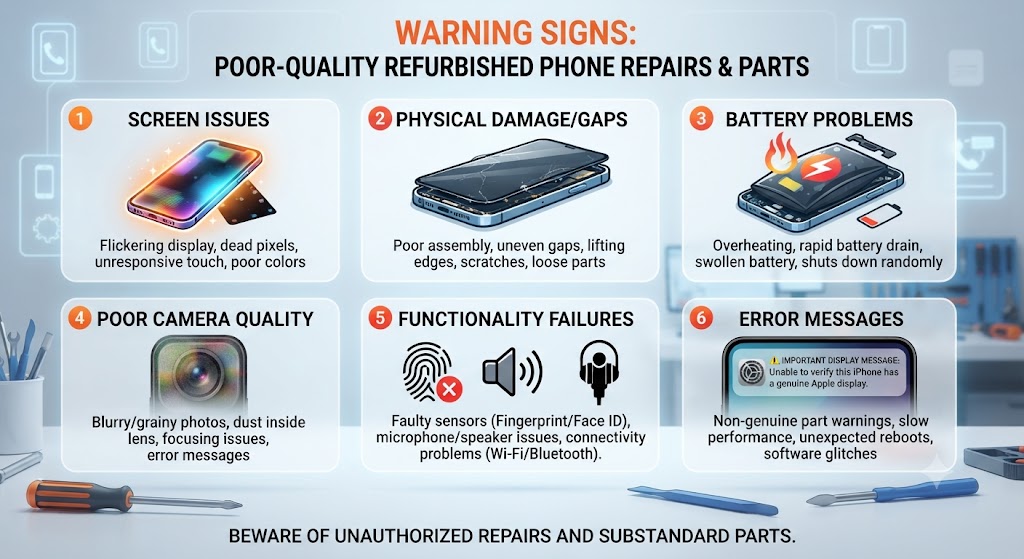
Not every repaired phone has been refurbished to the same standard. While professional repairs can restore a device to excellent working condition, poor workmanship can reduce reliability, affect performance and lead to costly problems later.
Knowing what to look for can help you avoid buying a device that hasn’t been repaired properly. Below are some of the most common warning signs.
1. Uneven Screen Alignment
The display should sit flush with the phone’s frame.
If you notice gaps around the edges, one side sitting higher than the other or the screen lifting away from the frame, it could indicate that the display wasn’t fitted correctly or the adhesive wasn’t applied properly.
2. Poor Touchscreen Performance
A replacement display should feel just as responsive as the original. Be cautious if you notice:
- Delayed touch response
- Missed taps or swipes
- Ghost touches
- Areas of the screen that don’t respond
- Inconsistent scrolling
These issues may suggest a low-quality replacement screen or an incorrectly fitted display.
3. Low Display Quality
The screen should produce clear, vibrant and consistent images. Watch out for:
- Dull colours
- Yellow or blue colour tint
- Low brightness
- Screen flickering
- Dead pixels
- Uneven backlighting
These problems can sometimes indicate poor-quality replacement parts.
4. Loose Buttons or Ports
Every button should feel firm and responsive. Check the:
- Power button
- Volume buttons
- Silent switch (iPhone)
- Charging port
- SIM tray
Loose or poorly fitted components may suggest that the phone has previously been opened and reassembled without proper care.
5. Poor Camera Performance
The cameras should focus quickly and produce sharp images. Test:
- Front camera
- Rear cameras
- Portrait mode
- Video recording
- Flash
- Autofocus
Blurry images, focusing problems or dust inside the camera lens may indicate an incomplete repair.
6. Weak Battery Performance
A professionally refurbished phone should provide dependable battery life. Possible warning signs include:
- Rapid battery drain
- Unexpected shutdowns
- Battery percentage changing suddenly
- Device becoming unusually hot while charging
These symptoms could indicate an ageing battery or a low-quality replacement battery.
7. Charging Problems
The charging port should work consistently. Signs of concern include:
- Charger feels loose
- Charging starts and stops
- Slow charging
- Phone only charges at certain angles
These issues may indicate a damaged or poorly replaced charging port.
8. Unusual Sounds
A healthy smartphone should operate quietly. Be cautious if you hear:
- Buzzing speakers
- Distorted audio
- Crackling during calls
- Vibrations that sound loose
Audio problems can sometimes result from poor-quality repairs or damaged internal components.
Questions to Ask Before Buying a Refurbished Phone
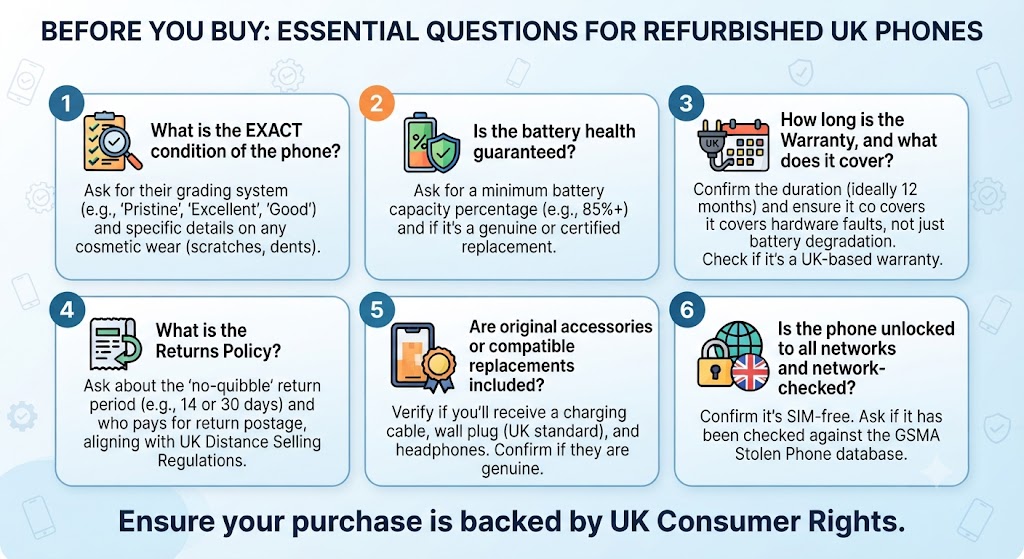
Buying from a trusted retailer is important, but asking a few simple questions can give you even greater confidence in your purchase. Consider asking:
- Has this phone had any replacement parts fitted?
- What tests were carried out before the phone was listed for sale?
- Is the battery still within acceptable health standards?
- Does the phone include a warranty?
- What is your returns policy?
- Has the IMEI been checked?
- Has the phone passed a full diagnostic test?
- What cosmetic grade does this phone have?
- Are all features fully functional?
- Has the device been securely data wiped?
A reputable retailer should be happy to answer these questions clearly and honestly.
Professionally Refurbished vs Poorly Repaired Phones
One of the biggest mistakes buyers make is assuming that every repaired phone is the same.
In reality, there is a significant difference between a professionally refurbished device and one that has simply been repaired without proper testing or quality control.
| Professionally Refurbished Phone | Poorly Repaired Phone |
|---|---|
| Thoroughly inspected before sale | Limited or no inspection |
| Professionally tested hardware | Basic functionality only |
| High-quality replacement parts where required | Unknown or low-quality parts may be used |
| Secure data erasure | Previous data may not have been removed correctly |
| Cosmetic grading provided | Condition often described vaguely |
| Warranty included | Little or no warranty |
| Clear return policy | Limited buyer protection |
| Reliable customer support | Support may be unavailable after purchase |
This is one of the main reasons why buying from a trusted refurbishment specialist is generally much safer than purchasing from an unknown private seller.
Refurbished Phone Buying Checklist
Before completing your purchase, work through this simple checklist.
| Check | Complete |
|---|---|
| Phone has been professionally refurbished | ☐ |
| IMEI has been verified | ☐ |
| Battery health is acceptable | ☐ |
| All cameras have been tested | ☐ |
| Display works correctly | ☐ |
| Face ID or fingerprint sensor works | ☐ |
| Charging port functions normally | ☐ |
| Speakers and microphones work properly | ☐ |
| Warranty is included | ☐ |
| Seller has positive customer reviews | ☐ |
| Return policy is clearly explained | ☐ |
| Cosmetic condition matches the advertised grade | ☐ |
Completing these checks takes only a few minutes but can greatly reduce the risk of buying a device that doesn’t meet your expectations.
Should You Buy a Refurbished Phone That Has Been Repaired Before?
In many cases, yes. A previous repair doesn’t automatically reduce a phone’s quality or reliability. What matters is whether the repair was carried out professionally, whether the device was thoroughly tested afterwards and whether it is backed by a trusted retailer.
Many refurbished phones receive routine repairs such as battery or screen replacements as part of the refurbishment process. When completed to a high standard, these repairs can actually improve the device’s performance and extend its lifespan. Instead of focusing solely on whether a phone has been repaired, concentrate on the factors that matter most:
- The reputation of the retailer
- The quality of the refurbishment process
- Comprehensive device testing
- Warranty coverage
- Transparent grading
- Clear return policy
These factors provide a much better indication of the phone’s overall reliability than its repair history alone.
Why Buy Your Refurbished Phone from iExpert Market?
At iExpert Market, we understand that buying a refurbished phone is about more than simply saving money – it’s about buying with confidence. Every device is professionally inspected, tested and quality checked before it becomes available for sale. Our technicians assess key hardware components, verify functionality, securely erase previous data and ensure that each phone meets our refurbishment standards.
When you shop with iExpert Market, you also benefit from:
- Professionally tested refurbished devices
- Transparent cosmetic grading
- Competitive UK pricing
- Warranty-backed purchases
- Secure online ordering
- Carefully selected range of refurbished iPhones and Samsung phones
- Friendly UK customer support
Whether you’re upgrading your current device or buying your first refurbished smartphone, our goal is to provide dependable technology and complete peace of mind.
If you’re ready to upgrade, explore our collection of Refurbished iPhones or Refurbished Samsung Phones to find a professionally refurbished device that suits your needs.
Conclusion
Buying a refurbished phone doesn’t mean you’re buying a device with a questionable past. In fact, many refurbished smartphones have only undergone routine repairs such as a battery or screen replacement before being professionally tested and certified for resale. The key isn’t whether a phone has been repaired – it’s how the repair was carried out.
A professionally refurbished device should be thoroughly inspected, tested, securely data-wiped, cleaned, and verified to ensure it performs reliably. Reputable retailers are transparent about their refurbishment process, provide warranties, and perform extensive quality checks before any device reaches a customer.
Before making a purchase, always take the time to check the phone’s physical condition, verify the IMEI number, review battery health where possible, understand the seller’s refurbishment process, confirm that a warranty is included, and buy from a trusted UK refurbished phone specialist. Following these simple steps will help you buy with confidence while avoiding many of the risks associated with private second-hand sales.
Frequently Asked Questions (FAQs)
1. How can I tell if a refurbished phone has been repaired before?
You can inspect the phone for signs such as uneven panel gaps, poor screen alignment, mismatched colours, glue residue or replaced screws. It’s also important to ask the seller about the refurbishment process and check whether a warranty is included.
2. Is it normal for refurbished phones to have replacement parts?
Yes. Many professionally refurbished phones receive replacement batteries, screens or charging ports during refurbishment. These are routine repairs that help restore performance and reliability.
3. Are repaired refurbished phones reliable?
Yes, provided the repairs have been completed professionally using quality replacement parts and the device has passed comprehensive testing before being sold.
4. How do I know if a refurbished iPhone has a new battery?
On supported iPhones, go to Settings > Battery > Battery Health & Charging to view battery information. Many trusted retailers also state whether the battery has been replaced during refurbishment.
5. Is a replaced screen a problem on a refurbished phone?
Not necessarily. A professionally fitted replacement screen should provide excellent display quality and touch responsiveness. The quality of the repair is more important than whether the screen has been replaced.
6. Can I check a refurbished phone’s repair history?
There is no universal repair history database. However, buying from a reputable retailer that explains its refurbishment process and includes a warranty offers greater confidence.
7. Should I avoid refurbished phones that have had motherboard repairs?
Not always, but motherboard repairs require specialist expertise. If the device has undergone complex repairs, it’s best to purchase from a trusted refurbishment company that fully tests the phone and provides warranty protection.
8. How do I check if a refurbished phone is genuine?
Verify the IMEI number, check that the phone matches the seller’s description, inspect the build quality, and buy from an established UK retailer rather than an unknown private seller.
9. Does replacing the battery make a refurbished phone better?
In many cases, yes. A new battery can improve battery life, charging performance and the overall user experience, especially on older devices.
10. Are refurbished phones tested before being sold?
Professional refurbishment companies usually perform extensive functional testing, including checks on the display, cameras, speakers, microphones, charging system, battery, connectivity and overall performance.
11. How can I tell if a phone has been opened before?
Small marks around screws, uneven display alignment, damaged seals or visible adhesive residue may indicate that a phone has previously been opened.
12. Should a refurbished phone include a warranty?
Yes. A warranty shows that the retailer has confidence in the quality of its refurbishment process and provides additional peace of mind if a hardware fault develops later.
13. Can I trust refurbished phones bought online?
Yes, provided you purchase from a reputable UK retailer with transparent refurbishment standards, customer reviews, secure payment options and warranty coverage.
14. Is buying a refurbished phone better than buying a used phone?
For most buyers, yes. Professionally refurbished phones are tested, cleaned and backed by warranty, whereas privately sold used phones are often sold without inspection or after-sales support.
15. How much money can I save by buying refurbished?
Depending on the model and condition, refurbished phones can often cost significantly less than buying new while offering similar everyday performance.
16. Do refurbished phones still receive software updates?
Yes. As long as the device is supported by the manufacturer, refurbished phones continue to receive software and security updates in the same way as new devices.
17. Can refurbished phones be waterproof after repair?
If a phone has been opened for repair, the original water-resistant seals may no longer provide the same level of protection unless they have been professionally replaced. Water resistance should never be guaranteed after repair unless specifically stated by the refurbisher.
18. What should I ask before buying a refurbished phone?
Ask whether the phone has been tested, what parts (if any) have been replaced, whether a warranty is included, the battery condition, the device grade and the retailer’s return policy.
19. Where is the safest place to buy a refurbished phone in the UK?
The safest option is to buy from a trusted UK refurbished phone retailer that provides professionally tested devices, transparent grading, warranty protection and reliable customer support.
20. Is buying a refurbished phone worth it?
Absolutely. For many buyers, refurbished phones offer the best balance of price, performance and sustainability. Choosing a professionally refurbished device from a reputable retailer can provide excellent value while reducing electronic waste.
Back to posts